
The arrival of the Final Order can feel like the end of everything.
The marriage has legally ended. The divorce application has disappeared from the court portal. You are free to remarry. There may be nothing left to sign and no further divorce hearing to attend.
It is therefore entirely understandable to think:
“That is it. Everything between us is finished.”
But in England and Wales, that conclusion can be dangerously wrong.
A Final Order, previously called the Decree Absolute, ends the marriage. It does not automatically divide the family home, share pensions, deal with savings, allocate debts or prevent either former spouse from making financial claims later. Financial claims after divorce can therefore remain open even when the marriage itself has legally ended.
The legal divorce process and the financial settlement are connected, but they are not the same legal process. Resolving finances following divorce may require a separate consent order or financial remedy proceedings.
That distinction matters even where the separation was amicable. It matters where the parties have already divided everything informally. It matters where there appears to be very little money. It can matter even many years after the divorce was completed.
The important question is not only whether the divorce is finished. It is whether the financial claims arising from the marriage have been formally resolved and dismissed.
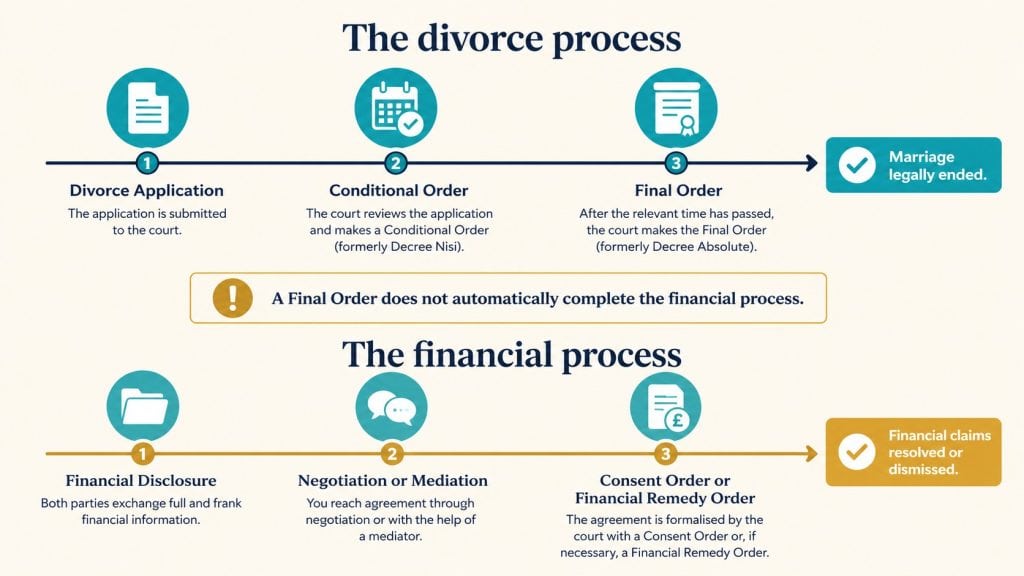
What does the Final Order actually do?
The Final Order legally dissolves the marriage.
It changes your marital status, allows you to remarry and completes the divorce application. What it does not normally do is decide what should happen to the money and property accumulated before, during or sometimes after the marriage.
Those questions are dealt with through financial orders under the Matrimonial Causes Act 1973.
The court can make orders dealing with property, lump sums, maintenance and pensions. When deciding what outcome is fair, it must consider all the circumstances of the case, with particular attention to the factors listed in section 25 of the Matrimonial Causes Act 1973. These include each person’s income, earning capacity, property, financial resources, needs, responsibilities, age, health and the duration of the marriage.
Where there is a child of the family under the age of 18, the court must give first consideration to that child’s welfare while considering the financial circumstances of the case. This does not mean the financial decision becomes a child-arrangements decision. It means the practical effect on the child, particularly housing and stability, cannot simply be ignored.
This leaves two separate legal questions:
Are we still married?
and:
Have our financial claims against one another been brought to an end?
The Final Order answers only the first.
Why a private agreement may not be enough
Many couples divide their finances themselves.
One person keeps the car. The other keeps the savings. The house is sold or transferred. Joint accounts are closed. Each person agrees not to ask the other for anything else.
That arrangement may work perfectly well in everyday life. The difficulty is that an informal agreement does not usually provide the same protection as a court order.
GOV.UK explains that, to make a financial agreement legally binding, the parties need to turn it into a consent order and ask the court to approve it. Without that approval, the agreement may not be enforceable if one person later changes their mind or stops doing what was agreed.
A consent order records the financial terms agreed between the parties. Depending on the case, it might provide for the sale or transfer of property, payment of a lump sum, pension sharing, ongoing maintenance or the dismissal of future claims.
The parties usually provide the court with financial information through Form D81. This helps the judge understand the proposed outcome and decide whether the arrangements appear fair.
The judge is not expected simply to approve whatever is placed in front of the court. A consent order receives its legal authority from the court, not merely from the signatures of the two former spouses.
This is why a handwritten agreement saying “we will each keep what is in our own name” is not necessarily the final protection people believe it to be.
It may record an intention. It may be relevant evidence. But it may not close the financial claims arising from the marriage.
A consent order and a clean break are not exactly the same thing
The terms are often used as though they mean the same thing, but they describe different ideas.
A consent order is a financial order whose terms have been agreed by the parties and approved by the court.
A clean break means that future financial obligations and claims between the former spouses are dismissed, either immediately or after the other parts of the order have been completed.
A consent order may contain a clean break, but not every consent order creates an immediate clean break. An order could, for example, include continuing spousal maintenance.
Equally, a clean-break order can be made following contested proceedings rather than through agreement.
A clean break also does not mean that nobody receives anything.
One person might receive a lump sum, a share of a pension or a transfer of property. Once those provisions have been completed, the remaining claims may then be dismissed.
The clean break relates to the ending of the legal financial relationship. It does not tell you how large or small the settlement must be.
Can financial claims after divorce remain open for years?
People sometimes assume that a financial order is unnecessary because there was little or nothing to divide at the time.
There may have been no property, no significant savings and no valuable pension. Both people may have been earning modest incomes. They may have felt that paying for a formal order was pointless.
The problem is that an unresolved claim does not necessarily remain tied to the financial position on the day of divorce.
A former spouse may later buy a home, build a business, accumulate savings or receive other assets. That does not automatically mean the other former spouse will be entitled to share in everything acquired afterwards.
The source of the wealth, the length of the separation, the parties’ present needs and all the surrounding circumstances may be important.
But the absence of a financial order can mean that the court’s jurisdiction was never formally brought to an end.
The clearest example is the Supreme Court case of Wyatt v Vince.
The couple had separated in the 1980s and divorced in 1992. The former wife began financial proceedings almost two decades after the divorce, by which time the former husband had become wealthy through a successful business.
The Supreme Court did not decide that she was entitled to share equally in wealth created long after the marriage. It decided that her application should not simply have been struck out without proper consideration.
The lesson from the case is often misunderstood.
It does not mean that an ex-spouse can wait 20 years and automatically take half of everything.
It means there is no general statutory time limit that automatically extinguishes every financial claim after a set number of years. Delay can weaken a claim, reduce what may realistically be awarded and make the proceedings more difficult. It does not necessarily remove the court’s power to consider the application.
The family home may be the most visible asset, but not the most valuable one
Financial discussions often become centred on the house.
Who stays there? Can it be transferred? Does it need to be sold? How much equity is available?
Those are important questions, particularly when children need secure housing. But the home should not be viewed in isolation.
Keeping a property can look like the better outcome on paper while leaving the person who keeps it unable to afford the mortgage, repairs, insurance and ordinary living costs.
A property valued at £400,000 with a £250,000 mortgage is not simply “worth £400,000” to the person receiving it. The useful value is closer to the equity, and even that does not show whether the mortgage can be transferred or whether the lender will agree to release the other borrower.
A court order directing one spouse to take responsibility for a joint mortgage also does not, by itself, rewrite the lender’s contract.
Unless the lender releases a person from the mortgage, both borrowers may remain liable to the bank. An agreement between former spouses cannot remove the lender’s rights.
This is one of the practical differences between a settlement that looks attractive and one that can actually be implemented.
A sensible proposal must consider not only what an asset is worth, but whether the proposed recipient can retain, refinance, maintain or realise it.
Pensions are often the asset people understand least
Pensions do not feel like ordinary money.
They may not be accessible for years. They do not appear in a bank account and they cannot usually be spent on immediate housing needs. For that reason, they are frequently ignored or exchanged too casually for a larger share of the family home.
That can be a serious mistake.
Pensions may be among the largest assets in a divorce and can sometimes be worth more than the family home. The principal ways of addressing pensions include pension sharing, pension attachment and pension offsetting against other assets.
The starting figure is often the Cash Equivalent Transfer Value, usually called the CETV.
But a CETV is not always a complete expression of a pension’s practical value.
A £150,000 defined-contribution pension pot and a defined-benefit pension with a £150,000 CETV may provide very different future benefits.
One may depend heavily on investment performance. The other may provide guaranteed or inflation-linked income, dependants’ benefits or particular retirement rights.
The headline figures may look equal while the financial outcomes are not.

That is why comparing house equity with a pension on a pound-for-pound basis can be misleading.
Property provides accessible capital and housing today. A pension provides income or capital later, often with different tax treatment, risks and restrictions.
Someone who keeps £100,000 of property equity does not necessarily receive the financial equivalent of someone who keeps a pension with a stated value of £100,000.
Where pensions are significant or complicated, specialist pension advice or a report from a Pension on Divorce Expert may be justified.
Why the timing of the Final Order can matter
People understandably want their divorce completed as soon as possible.
Obtaining the Final Order may feel like emotional closure. But where finances remain unresolved, the timing should be considered carefully.
GOV.UK explains that it is usually simpler to seek approval of a consent order after the Conditional Order but before the Final Order. It warns that applying after the Final Order may have financial consequences, particularly in relation to pensions. A consent order can be approved only after the Conditional Order and takes effect after the Final Order.
The precise risk depends on the circumstances and the rules of the pension scheme. Rights connected with death benefits, survivor benefits or a person’s status as a spouse may change once the marriage ends.
Tax can also require careful consideration. The tax treatment of property, shares or investments can depend on when and how a transfer takes place.
A settlement should therefore consider the cost of implementing the agreement, not only the headline value being transferred.
The point is not that the Final Order should always be delayed.
The point is that it should not be treated as a purely administrative button when significant financial issues remain open.
Sole ownership does not automatically mean sole relevance
Another common misunderstanding is that an asset belongs only to the person whose name appears on it.
Legal ownership is important, but it does not automatically decide how the asset will be treated within financial remedy proceedings.
A property, savings account, investment portfolio, business or pension held in one spouse’s sole name may still need to be disclosed and considered.
Disclosure and division are separate questions.
First, the parties need to establish what assets and liabilities exist.
Only then can they consider whether a particular asset should be shared, retained, excluded or used to meet needs.
A person should not refuse to disclose an asset merely because they believe it should ultimately remain theirs. That argument comes after disclosure, not instead of it.
Not everything is automatically divided equally
It is often said that divorce begins with a 50/50 split.
That statement contains part of the picture, but it is too simple to be relied upon.
The court has a wide discretion and must consider the section 25 factors. In many ordinary cases, needs dominate the outcome because there is not enough wealth to provide both former spouses with everything they would ideally want.
Housing, mortgage capacity, income, childcare responsibilities, health and earning capacity may matter more than abstract percentages.
In cases where the available assets exceed both parties’ needs, the distinction between matrimonial and non-matrimonial property can become more important.
Matrimonial property generally refers to wealth produced by the marital partnership or common endeavour. Non-matrimonial property may include assets owned before the marriage or received through an external gift or inheritance.
How an asset was treated during the marriage can still matter.
In Standish v Standish, decided by the Supreme Court on 2 July 2025, the Court confirmed that the sharing principle applies to matrimonial property rather than non-matrimonial property.
The Court also confirmed that legal title alone does not decide whether property is matrimonial or non-matrimonial. On the facts of that case, transferring assets into the wife’s name for tax-planning purposes had not transformed most of those assets into matrimonial property.
Standish involved exceptional wealth, and it should not be treated as a simple formula for ordinary needs-based cases.
An inherited or pre-marital asset is not automatically protected where the available resources are insufficient to meet reasonable housing or income needs.
Inheritance is not automatically protected or automatically shared
Inheritance is frequently discussed in absolute language.
One person says:
“It was inherited, so it cannot be included.”
The other says:
“We were married, so half of it belongs to me.”
Neither statement is reliable in every case.
An inheritance may be treated as non-matrimonial property, particularly where it was received separately and remained separate.
But its treatment can depend on when it was received, what happened to it, whether it was used for the family and whether the remaining assets are sufficient to meet reasonable needs.
Inherited money used to purchase the family home may be treated differently from an inheritance received shortly before separation and retained in a separate account.
An asset can also change its practical character through the way the family uses it. This is sometimes described as “matrimonialisation”, although the label should not replace careful examination of what actually happened.
Future inheritance is even more uncertain.
A belief that someone will one day inherit from a parent is not the same as an asset already received. Wills can change, assets can be spent and care costs can reduce an estate.
A speculative expectation should not normally be treated like money already available.
Business value is rarely the same as turnover
Business interests create some of the most persistent misunderstandings in financial remedy cases.
The non-owning spouse may see annual turnover of £500,000 and assume that the business must be worth a similar amount.
The owner may say that the business has no value because it depends on their personal work.
Neither position is necessarily correct.
Turnover is the amount passing through the business. It is not profit.
Profit is not automatically the amount available to the shareholder.
Money shown in a company account may be required for tax, salaries, stock, working capital or existing obligations.
Equally, a business may have value that is not obvious from its physical assets. Recurring contracts, intellectual property, customer relationships, specialist licences, goodwill and the ability to generate maintainable profits may all be relevant.
The useful question is not simply:
“How much money is in the company?”
It is:
“What is the value of the interest owned by this spouse, what income can reasonably be drawn from it, and how much of that value could realistically be realised without damaging the business?”
Those questions may produce different answers.
When is an independent business valuation necessary?
Not every small business requires an expensive expert report.
Straightforward accounts, tax returns and information from the company’s accountant may be enough where the figures are clear and broadly accepted.
An independent valuation becomes more useful where the business is valuable, unusually structured, growing quickly, connected to other companies, holding significant assets or producing figures that cannot easily be reconciled with the owner’s income and lifestyle.
Within court proceedings, expert evidence is controlled by Part 25 of the Family Procedure Rules.
The court’s permission is required before expert evidence can be placed before it, and permission should be given only where the evidence is necessary to resolve the proceedings.
Where appropriate, a single jointly instructed expert may be used so that the expert assists the court independently rather than acting as an advocate for one side.
An expert valuation is not a guaranteed sale price.
It is a professional assessment based on evidence, assumptions and recognised valuation methods. The assumptions may be as important as the final figure.
Debts require context, not just a balance
Financial remedy proceedings are not limited to dividing positive assets.
Debts can substantially change what is available.
A credit card, personal loan or tax liability may be legally owed to the lender by one person alone. That does not necessarily decide how the debt will be treated between the former spouses.
The court may need to understand when the debt arose, why it was incurred and what the borrowed money was used for.
Debt used to meet family living costs during separation may be viewed differently from unexplained personal expenditure.
Borrowing used to preserve the family home may have a different significance from borrowing accumulated after separation for an unrelated purpose.
Likewise, one person paying a joint liability does not automatically guarantee reimbursement pound for pound.
Financial remedy proceedings are not a perfect historical accounting exercise. The court is looking for a fair overall result.
That makes documentary evidence important. A liability without supporting statements, agreements or a coherent explanation should not simply be accepted at face value.
Full and frank disclosure is the foundation of any fair settlement

A settlement cannot be assessed properly unless the financial picture is reasonably complete.
In contested proceedings, each party will normally provide detailed financial disclosure through Form E, supported by documents dealing with property, mortgages, accounts, investments, pensions, businesses, income and liabilities.
The duty is not satisfied by disclosing only what one person believes should be shared.
It is also not satisfied by providing a large number of documents without addressing the central questions.
The Supreme Court has confirmed that parties in financial proceedings owe a duty of full and frank disclosure. A consent order derives its authority from the court, and the court cannot perform its section 25 task properly if material financial information has been withheld.
In Sharland v Sharland, the Supreme Court considered a proposed settlement affected by fraudulent non-disclosure concerning the husband’s business.
In Gohil v Gohil, the Court again addressed a former spouse’s failure to provide full and frank disclosure and the circumstances in which a financial order could be challenged.
Hidden assets are not always found in secret offshore accounts
The phrase “hidden assets” creates an image of money deliberately moved overseas.
That can happen, but incomplete disclosure is often less dramatic.
The problem might be a bank account that was omitted, an unexplained director’s loan account, cryptocurrency not mentioned, shares held through another company, money transferred to a relative, income routed through a business or liabilities presented without evidence.
Sometimes the most important issue is not a suspicious document.
It is a missing document.
A run of bank statements includes January, March and April, but not February.
A business reports healthy turnover, but the explanation of the owner’s income does not match the accounts.
Regular transfers leave one account, but the receiving account has not been disclosed.
An investment appears on one tax return and disappears from the next financial statement without explanation.
None of those points proves dishonesty on its own.
They identify questions that require answers.
A good questionnaire is not built from accusations. It is built from gaps, inconsistencies and documents that do not yet tell a coherent story.
Why missing information can matter more than the papers you already have
People sometimes arrive with hundreds of pages of disclosure and believe that the size of the bundle means the case must be ready for settlement.
It may not be.
Three years of bank statements may show spending patterns but tell you nothing reliable about the value of a company.
A pension statement may show a CETV but not the retirement income the pension is expected to provide.
Company accounts may show last year’s profit but not a major contract lost last month.
An estate agent’s estimate may suggest a property value but not identify repair costs, restrictions or whether either person can afford to retain it.
The useful question is not:
“How much paperwork have I received?”
It is:
“Does the information answer the questions that must be answered before a fair decision can be made?”
A small number of well-chosen documents can be more useful than a large bundle containing everything except the key evidence.
Non-disclosure can undermine a financial order
A clean break is intended to create finality.
It is not intended to protect a settlement obtained through material dishonesty.
Not every forgotten account or minor error will justify reopening an order.
The missing information must be material. In other words, it must be significant enough that proper disclosure might have produced a substantially different decision or agreement.
This is another reason not to treat a signed agreement as protection against every future problem.
The reliability of the agreement depends partly on the reliability of the information on which it was based.
The procedure for seeking to set aside a financial remedy order is addressed in Practice Direction 9A.
Fairness is about the outcome people will actually live with
A settlement may look equal on a spreadsheet and still produce radically different lives.
Imagine that two former spouses each receive assets with a headline value of £200,000.
One receives accessible capital and has a strong income and borrowing capacity.
The other receives mainly pension value, has primary responsibility for young children and cannot obtain a sufficient mortgage.
The numbers may look equal. Their ability to secure housing and meet everyday needs may not be.
This is why financial remedy proceedings cannot be reduced to a calculator.
The court must consider resources, needs, responsibilities, income and earning capacity.
In many families, the central issue is not how to produce perfect numerical equality. It is how to provide workable housing and financial stability from limited resources.
Where children are involved, this should not be turned into an argument about which parent deserves more.
The practical question is how the available resources can support the children’s stability while allowing both households to function.
The remarriage trap
One of the least understood timing risks arises when someone remarries before dealing with claims against a former spouse.
Section 28 of the Matrimonial Causes Act 1973 can prevent a person who has remarried from pursuing certain types of financial provision if the relevant application was not made before the new marriage.
This is commonly called the remarriage trap.
The detailed effect depends on the type of claim and what was included in the original divorce application.
Modern divorce applications commonly include an application for financial orders, but nobody should assume their position is protected without checking the actual documents.
The important practical point is simple:
Do not wait until after the wedding to find out whether your former marital finances were ever resolved.
A new relationship does not automatically close an old financial claim
Beginning a new relationship or living with somebody else does not itself create the same legal effect as remarriage.
Cohabitation may still be relevant. It can affect housing needs, household expenditure and the overall assessment of financial circumstances.
But it does not automatically dismiss claims against a former spouse.
This distinction can surprise people who believe that moving in with a new partner means the previous financial relationship has legally ended.
It may change the factual picture. It does not replace the need for a financial order.
How AI may help without deciding the case
AI can be useful during financial remedy proceedings, but its role should remain limited and practical.
It may help organise disclosure, summarise statements, compare repeated transactions, build a chronology and turn an emotional accusation into a clear request for information.
It can also explain unfamiliar terminology and help identify questions that have not yet been answered.
What AI cannot do is decide what settlement is fair.
It cannot know whether the documents supplied are complete. It cannot identify an asset that leaves no trace in the information it has been given.
It cannot test a person’s credibility, inspect a property or replace specialist pension, business, tax or legal advice.
Its most useful role is helping someone understand and organise the evidence they already have.
Its greatest weakness is that it sees only what it is shown.
For a fuller explanation, including privacy and accuracy risks, read my detailed guide to using AI safely in family court proceedings.
What should you do if the divorce is finished but no financial order was made?
The first step is to establish whether a financial order already exists.
People sometimes confuse the Final Order in the divorce with a financial order. Others remember signing documents but do not know whether the court ever approved them.
Look for a document dealing specifically with financial provision, property, pensions, maintenance, lump sums or the dismissal of claims.
If no such order exists, the next step is to understand the current financial position.
That normally means identifying the property, mortgages, pensions, savings, investments, business interests, debts, income and reasonable future needs on both sides.
Where agreement is possible and disclosure can be completed reliably, the parties may be able to negotiate terms and submit a consent order.
Where agreement is not possible, or there are serious concerns about disclosure, a formal financial remedy application may be required.
Part 9 of the Family Procedure Rules governs applications for a financial remedy.
Practice Direction 9A also expects parties to seek to resolve disputes without court proceedings where appropriate and to exchange relevant information before an application is made.
You can also read more about the family court support available through Everyman Justice.
The law is under review, but the existing rules still apply
The law governing financial remedies is more than 50 years old and has developed substantially through decisions made by the courts.
On 5 June 2026, the Government opened its A fairer end to relationships consultation.
The consultation proposes a “codification-plus” approach that would place established principles, including needs and sharing, more clearly into legislation. It also considers clearer definitions of matrimonial and non-matrimonial property and other possible reforms. The consultation closes on 14 August 2026.
These are proposals, not the current law.
Any responses to the consultation will need to be considered before legislation is developed, and any legislation would require parliamentary time.
For anyone dealing with finances now, the Matrimonial Causes Act 1973, existing case law and the current Family Procedure Rules remain the relevant framework.
Do not let the Final Order create false confidence
A Final Order is an important document.
It ends the marriage and confirms that the divorce itself is complete.
But it should not be mistaken for a complete financial settlement.
The financially decisive document may be the order that deals with the home, pensions, savings, debts, business interests, maintenance and future claims.
Without that order, two people may be legally divorced while remaining financially connected in ways neither of them fully appreciates.
The right question is therefore not simply:
“Is my divorce final?”
It is:
“Have our financial claims been disclosed, resolved and formally brought to an end?”
Those are different questions.
The safest time to understand the difference is before an unresolved claim becomes a new dispute.
Everyman Justice provides, including help with organising disclosure, understanding court documents and preparing for the financial remedy process.
You can read more about my practical, plain-English approach as a McKenzie Friend, view the areas covered and current fees, or contact Everyman Justice to discuss your circumstances.
Frequently Asked Questions
Does the Final Order automatically end financial claims?
No. The Final Order legally ends the marriage, but it does not normally dismiss financial claims between former spouses. A separate financial order is generally needed to resolve assets and formally close future claims.
Can my former spouse make a financial claim years after the divorce?
Potentially, yes. There is no general statutory deadline that automatically ends every financial claim after a fixed number of years. Delay may seriously affect what can realistically be claimed, but it does not necessarily remove the court’s jurisdiction.
Is an informal agreement between former spouses legally binding?
Not necessarily. A private agreement may provide evidence of what was intended, but it does not usually offer the same enforceability or dismissal of future claims as a consent order approved by the court.
Do we need a financial order if there is nothing to divide?
A clean-break order may still be worth considering because it can formally dismiss future claims. Whether an order is appropriate, and what disclosure is needed, depends on the circumstances.
Is a consent order the same as a clean break?
No. A consent order records terms agreed by the parties and approved by the court. A clean break dismisses future financial claims. A consent order may contain a clean break, but not every consent order creates an immediate clean break.
Is the family home always divided equally?
No. There is no automatic outcome that applies in every case. The court considers the available resources, housing needs, income, mortgage capacity, responsibilities and the other section 25 factors.
Are pensions automatically shared after divorce?
No. Pensions do not divide automatically. A pension-sharing order requires a financial order from the court. Pension values should still be considered even where the parties agree not to share them.
Is an inheritance excluded from a divorce settlement?
Not automatically. Its treatment may depend on when it was received, whether it was kept separate, how it was used and whether the remaining assets are sufficient to meet reasonable needs.
Can a business be valued using its turnover?
Turnover alone does not establish business value. Profitability, liabilities, working capital, ownership structure, maintainable earnings, goodwill and dependence on the owner may all be relevant.
What happens if an asset was hidden?
Material non-disclosure can lead to further investigation, costs consequences and, in an appropriate case, an application to set aside a financial order. A minor omission will not necessarily be enough; the missing information must have been capable of affecting the outcome.
Can AI calculate a fair divorce settlement?
No. AI can help organise information and identify questions, but fairness depends on complete disclosure, reliable evidence and the circumstances of the family. AI cannot know what information has been withheld or reliably predict a judge’s decision.
Should I obtain the Final Order before settling the finances?
That depends on the circumstances. GOV.UK warns that obtaining the Final Order before finances are resolved can have consequences, particularly for pensions. The timing should be considered rather than treated as automatic.
Important note
This article provides general information about financial remedies following divorce in England and Wales. It is not legal advice and cannot determine what outcome would be fair in an individual case.
Financial cases may involve tax, pensions, trusts, companies, overseas property, insolvency or inheritance issues. Advice from a regulated solicitor, tax adviser, financial adviser, accountant or pension expert may be necessary where specialist issues arise.
Need practical help with financial remedy proceedings?
Everyman Justice provides plain-English support with financial disclosure, court documents and preparation for financial remedy proceedings across England and Wales.
Leave a Reply