This guide explains how the Child Arrangements Order process UK parents go through in England and Wales works from start to finish. Many parents are unsure what happens after they submit the C100 form, what Cafcass does, or how long the court process takes.
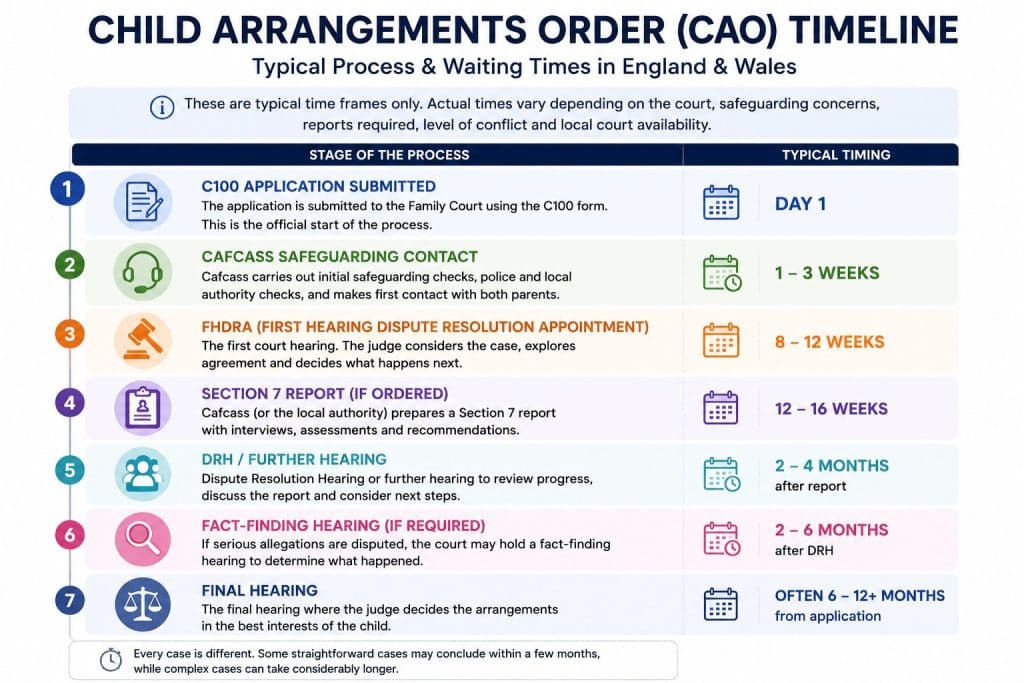
Whether you are applying for contact or responding to an application, understanding the structure of the process can help you stay calm, organised and child-focused.
What Is a Child Arrangements Order?
A Child Arrangements Order (CAO) is a court order that decides:
- Who a child lives with
- When and how a child spends time with each parent
- Whether contact is direct, indirect, supervised or remote
You can read more about practical preparation support on the
👉 Child Arrangements Order (CAO) Support page
Step 1: Submitting the C100 Application
The process usually begins with a C100 application to the Family Court.
This form sets out:
- What order you are asking for
- Current arrangements
- Any safeguarding concerns
- What outcome you believe is in your child’s best interests
Before applying, most parents must attend a MIAM (Mediation Information and Assessment Meeting), unless an exemption applies.
You can read the official guidance on the UK government website about applying for a Child Arrangements Order.
Step 2: Cafcass Safeguarding Call
After the court receives the application, Cafcass (Children and Family Court Advisory and Support Service) becomes involved.
Cafcass will usually:
- Contact both parents by phone
- Conduct police and local authority checks
- Identify safeguarding risks
- Provide initial recommendations to the court
What you say during this call matters.
For detailed preparation guidance, see:
👉 Cafcass Support Guidance
Step 3: FHDRA Hearing (First Hearing)
The first court hearing is usually the FHDRA (First Hearing Dispute Resolution Appointment).
At this stage, the court may:
- Explore whether agreement is possible
- Consider interim contact arrangements
- Decide whether further evidence is needed
- Order a Section 7 report
This hearing is usually short and procedural, but preparation makes a significant difference.
If your case is high conflict, structured preparation is particularly important:
👉 High-Conflict Family Court Support
How Pathfinder Is Changing Private Children Cases
In some areas of England and Wales, private children proceedings are now increasingly shaped by the Pathfinder approach. Pathfinder places greater emphasis on early safeguarding information, earlier understanding of risk, and a more problem-solving style of case management. In practice, this means courts may focus more heavily at an earlier stage on patterns of communication, allegations, the child’s experience, and whether parents are able to engage constructively with the process.
For many parents, this also changes the emotional experience of the case. Early safeguarding summaries and first impressions can sometimes feel far more important than their provisional nature may suggest, particularly for litigants in person trying to understand how the case is being viewed.
Step 4: Section 7 Report (If Ordered)
If the court needs more detailed information, it may order a Section 7 report.
This is a welfare assessment prepared by Cafcass or the local authority. It may involve:
- Interviews with both parents
- Meeting the child (depending on age)
- Reviewing school or medical information
- Assessing risk and parenting capacity
The report will include recommendations about future arrangements.
Not every case requires a Section 7 report.
Step 5: Final Hearing
If agreement is not reached earlier, the case proceeds to a final hearing.
At the final hearing:
• Both parents give evidence
• The judge considers all written material
• The court decides arrangements based on the child’s welfare
The judge’s decision is guided by the welfare checklist set out in Section 1 of the Children Act 1989.
How Long Does a Child Arrangements Order Case Take?
The length of a CAO case depends on:
- Level of conflict
- Safeguarding concerns
- Whether allegations are disputed
- Whether a Section 7 report is required
- Court availability in your area
Some cases conclude within a few months.
More complex cases — particularly where allegations are disputed or additional reports are required — can take a year or longer to resolve.
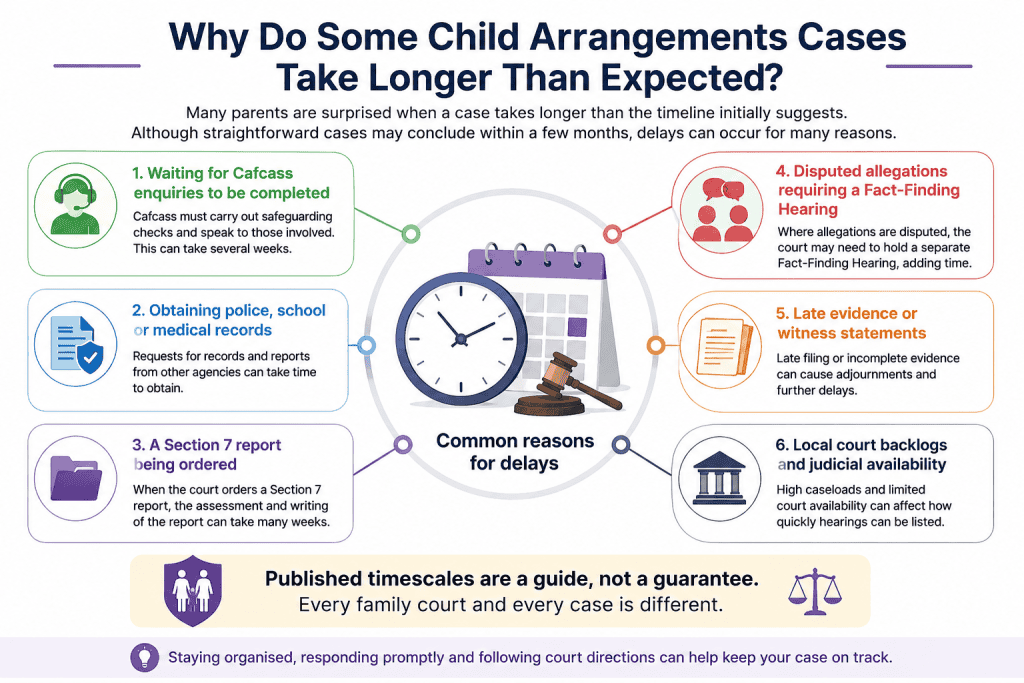
Delays often happen because Cafcass enquiries, Section 7 reports, disputed allegations, late evidence, or local court availability affect how quickly the case can move forward. Any timeline should therefore be treated as a guide, not a guarantee.
Common Mistakes Parents Make During the CAO Process
- Writing emotional, reactive statements
- Overloading the court with unstructured evidence
- Focusing on the other parent rather than the child
- Changing positions frequently
- Underestimating Cafcass involvement
Family courts respond best to calm, structured and child-focused presentation.
Courts are often helped more by clear chronology, consistent communication, and practical evidence than by emotionally reactive material submitted in frustration.
Many parents assume the case is effectively over once a final order is made. But where the order is still not followed in practice, a different set of problems can begin.
In reality, some parents later find themselves dealing with repeated cancellations, non-compliance, or questions about enforcement even after a final order has been made.
Do You Need a Solicitor for a CAO Case?
Not always.
Many parents represent themselves. What often matters more than legal jargon is:
- Structure
- Preparation
- Credibility
- Consistency
If you want practical support preparing your case, you can learn more here:
👉 Support & Help for Family Court Cases
Frequently Asked Questions About the CAO Process
1. Can the court make a decision at the first hearing?
Sometimes. If both parents agree or the issues are straightforward, interim arrangements may be made at the FHDRA.
If allegations or safeguarding concerns are raised, the court will usually direct further steps before making a final decision.
2. What happens if allegations are made?
The court may ask for written responses, order a Section 7 welfare report, or list a fact-finding hearing.
Allegations are not automatically accepted — decisions are based on evidence and the child’s welfare.
3. Will Cafcass speak to my child?
It depends on the child’s age and the court’s directions.
In some cases, Cafcass may speak directly with the child during a Section 7 investigation. In others, they gather information from parents and professionals.
4. How long does a Child Arrangements Order case take?
Timeframes vary widely.
Some cases conclude within a few months. Others — particularly those involving disputed allegations — can take a year or longer. Complex cases may take even more time depending on court availability and required reports.
5. Is mediation required before applying?
In most cases, yes. Parents must attend a MIAM (Mediation Information and Assessment Meeting) before applying to court unless an exemption applies, such as domestic abuse or urgency.
6. Can I represent myself in a CAO case?
Yes. Many parents attend family court without a solicitor.
The key is understanding the process, presenting your position clearly, and remaining child-focused throughout.
Need Calm, Practical Support During a CAO Case?
If you are currently preparing for a hearing in Colchester, I’ve written a separate page explaining how I support parents locally.
If you are navigating a Child Arrangements Order process and want structured preparation and practical guidance:
Phone: 07599 322717
Email: info@everymanjustice.co.uk
Vélemény, hozzászólás?