
This guide explains the Child Arrangements Order process in England and Wales, from making a C100 application through Cafcass involvement, court hearings and, where necessary, a final hearing.
The exact route can vary depending on safeguarding concerns, whether agreement is reached and which court is dealing with the case.
If you need practical help preparing your own case, see my Child Arrangements Order Support page.
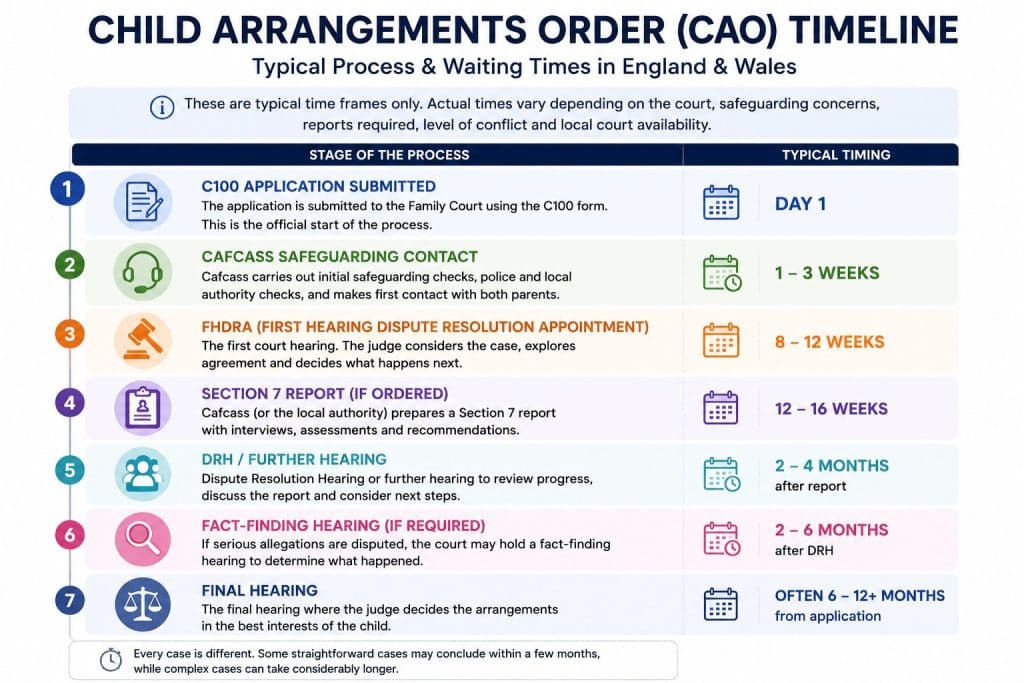
ary depending on court availability, safeguarding concerns and case complexity.
In areas using the newer Pathfinder / Child Focused Court approach, the sequence may differ from the traditional process outlined below.
What Is a Child Arrangements Order?
A Child Arrangements Order is an order under the Children Act 1989 that can decide where a child lives, when they spend time with another person and other arrangements for contact.
It may deal with matters such as direct contact, overnight stays, indirect contact or other arrangements appropriate to the child.
Step 1: Submitting the C100 Application
The process usually begins with a C100 application to the Family Court.
This form sets out:
- What order you are asking for
- Current arrangements
- Any safeguarding concerns
- What outcome you believe is in your child’s best interests
Before applying, most applicants must attend a Mediation Information and Assessment Meeting (MIAM) unless an exemption applies.
The current C100 form and online application are available through GOV.UK.
Step 2: Cafcass Safeguarding Call
In cases following the traditional Child Arrangements Programme, Cafcass will usually carry out safeguarding enquiries before the first hearing.
This commonly includes police and local authority checks and a telephone conversation with each party about any concerns for the child’s welfare or safety. Cafcass then provides the court with a safeguarding letter before the hearing.
For detailed preparation guidance, see my Cafcass Support page.
Step 3: FHDRA Hearing (First Hearing)
Where the traditional process applies, the first hearing is usually the First Hearing Dispute Resolution Appointment (FHDRA).
At this stage, the court may:
- Explore whether agreement is possible
- Consider interim contact arrangements
- Decide whether further evidence is needed
- Order a Section 7 report
This hearing is usually short and procedural, but preparation makes a significant difference.
If allegations or serious conflict are a major feature of the case, see my High-Conflict Family Court Support page.
Step 4: Section 7 Report (If Ordered)
If the court needs more detailed information about the child’s welfare, it may order a Section 7 report from Cafcass or the local authority.
The assessment may involve speaking with the parents, engaging with the child and obtaining information relevant to the issues the court has asked the adviser to investigate.
The report will normally include recommendations, but the court makes the final decision.
Not every case requires a Section 7 report.
Step 5: Final Hearing
If agreement is not reached earlier, the case proceeds to a final hearing.
At the final hearing:
- Both parents give evidence
- The judge considers all written material
- The court decides arrangements based on the child’s welfare
The judge’s decision is guided by the welfare checklist set out in Section 1 of the Children Act 1989.
How Long Does the Child Arrangements Order Process Take?
The length of a CAO case depends on:
- Level of conflict
- Safeguarding concerns
- Whether allegations are disputed
- Whether a Section 7 report is required
- Court availability in your area
Some cases conclude within a few months.
More complex cases — particularly where allegations are disputed or additional reports are required — can take a year or longer to resolve.
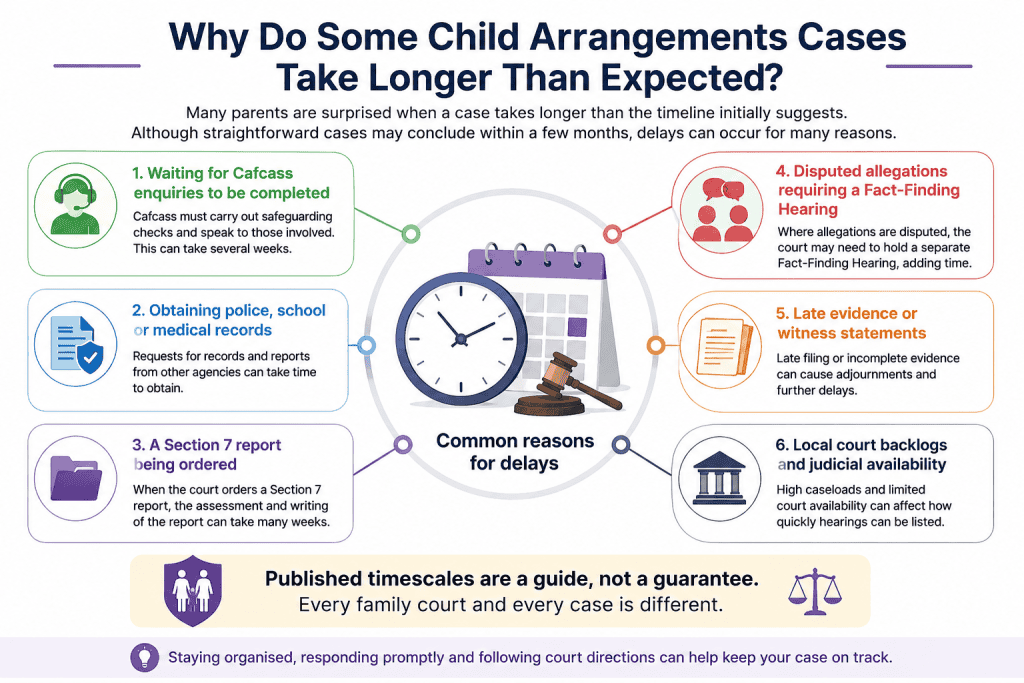
Delays often happen because Cafcass enquiries, Section 7 reports, disputed allegations, late evidence, or local court availability affect how quickly the case can move forward. Any timeline should therefore be treated as a guide, not a guarantee.
Common Mistakes Parents Make During the CAO Process
- Writing emotional, reactive statements
- Overloading the court with unstructured evidence
- Focusing on the other parent rather than the child
- Changing positions frequently
- Underestimating Cafcass involvement
Clear chronology, consistent communication and focused evidence are generally more useful than large amounts of repetitive or emotionally reactive material.
If a final order has already been made but the arrangements are not being followed, see my separate guide: What Happens if a Child Arrangements Order Is Not Followed?.
Can You Represent Yourself in a Child Arrangements Case?
Yes. Many parents represent themselves in Family Court.
A McKenzie Friend can provide practical support with preparation, documents and hearings while you remain responsible for conducting your own case.
For more information, see Support & Help for Family Court Cases.
Need Practical Support With a Child Arrangements Case?
If you are representing yourself in Child Arrangements proceedings and need help understanding the next stage, organising documents or preparing for a hearing, I provide practical McKenzie Friend support.
Leave a Reply