
Yes. AI for family court cases can be extremely useful, particularly if you are representing yourself—but you need to know how to use it safely.
It can help you understand the process, organise your evidence, prepare clearer documents and ask better questions. For many Litigants in Person, it can provide practical assistance that would previously have been difficult or expensive to obtain.
But using AI well is very different from allowing it to run your case.
AI does not know your family. It has not read every document unless you provide them. It cannot see what is missing from the information you give it, and it cannot reliably decide who is telling the truth. It may produce an answer that sounds certain even when the answer is incomplete, outdated or simply wrong.
The right approach is not to avoid AI. It is to understand what job you are asking it to do.
Use AI as a research assistant, organiser, writing assistant and critical reader. Do not treat it as your solicitor, your witness, your expert or the judge who will decide the case.
That distinction is the foundation of this guide.
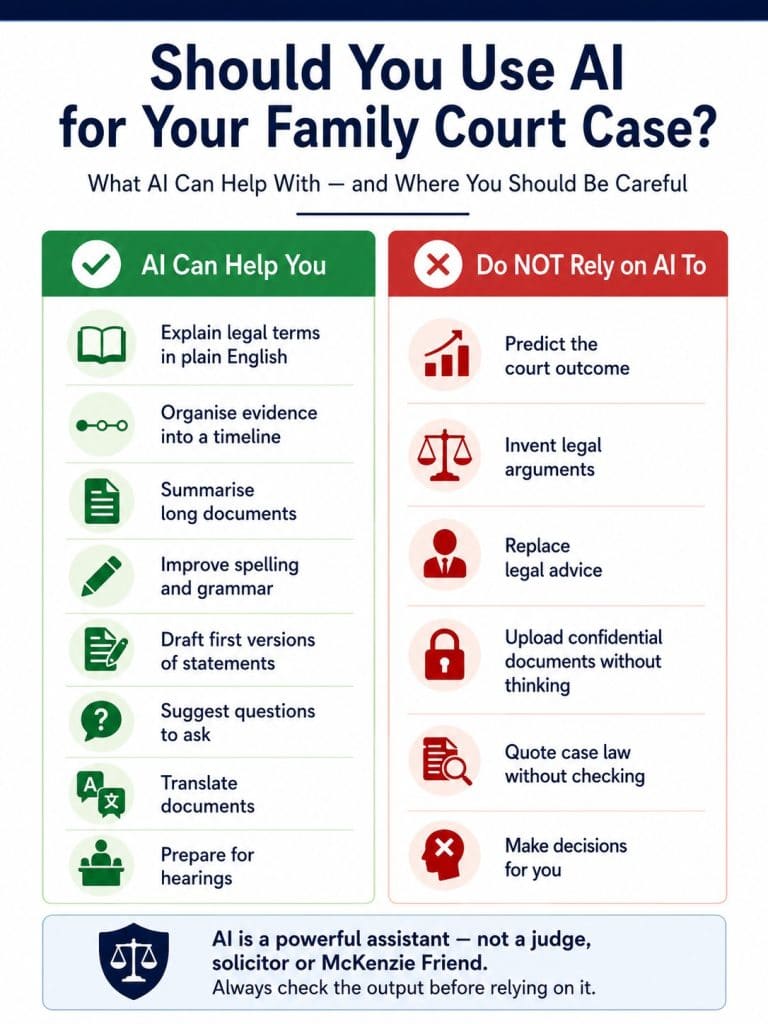
AI is already becoming part of the legal system
There is sometimes a strange double standard in discussions about AI and family law. Parents are warned that AI is dangerous, while law firms, legal publishers and professional advisers are already investing heavily in it.
Solicitors increasingly use technology to search documents, summarise correspondence, produce initial drafts, compare versions, carry out legal research and automate routine forms. The Solicitors Regulation Authority does not prohibit this. Its current position is that solicitors may use appropriate technology, including AI, but remain professionally responsible for confidentiality, competence, accuracy and the work ultimately delivered to the client.
In May 2025, the SRA authorised the first law firm in England and Wales designed to provide regulated legal services through an AI-led model. That did not mean the software was allowed to operate without responsibility or oversight. It meant AI was being used inside a regulated structure where professional obligations still applied.
The judiciary is also approaching the subject with more balance than some headlines suggest. In April 2026, the Chancellor of the High Court observed that AI can improve access to justice and that material produced by unrepresented litigants is sometimes clearer and more coherent than comparable material seen in the past. The Master of the Rolls has similarly said that judicial colleagues have noticed improvements in written and oral submissions prepared by Litigants in Person using AI.
That is important because it moves the discussion away from the simplistic idea that “AI equals bad legal work”.
Poor use of AI can certainly cause serious problems. So can poor information from social media, an outdated website, a confident friend or a professional who has misunderstood the case. The source of an answer matters, but so does the way it is checked.
The better question is therefore not whether AI belongs anywhere near family law. It is already there.
The better question is how a parent can use it in a controlled, intelligent and honest way.
Can you legally use AI in the Family Court?
There is no general rule in England and Wales preventing a Litigant in Person from using AI to help understand a case or prepare a court document.
You do not commit an offence simply by asking ChatGPT, Gemini, Claude, Copilot or another tool to explain part of a court order, organise a chronology or help improve the structure of a position statement.
At present, there is also no general Family Court rule requiring a parent to label every document that has received some AI assistance. That position may develop as courts and regulators consider more specific guidance. The Civil Justice Council has already examined the use of AI in preparing court documents, including its use by Litigants in Person.
What does not change is your personal responsibility.
When a document is filed in your name, you are responsible for it. If you sign a statement of truth, you are confirming that you honestly believe the facts stated in the document are true. Saying later that a chatbot created an inaccurate paragraph will not transfer that responsibility to the technology.
The same principle applies when solicitors use AI. The SRA says that a firm remains accountable for the output. A parent representing themselves should work on the same basis: AI may assist with the preparation, but the person submitting the material owns the final result.
This is different from the position sometimes reported from individual courts in the United States. America does not have one single national rule governing AI use in every court. Some US judges and court systems have introduced local requirements concerning disclosure, verification or certification of AI-assisted filings. Those rules do not automatically apply in England and Wales.
Do not therefore assume that an American headline saying “courts ban AI” describes the law in the Family Court here.
In England and Wales, the present practical position is more straightforward: you may use AI, but you must not mislead the court, invent evidence, file false legal authorities, breach confidentiality or sign something you have not properly checked.
Why parents are already using AI
Most parents do not turn to AI because they want a robot lawyer. They use it because the family justice process can be difficult to navigate without regular professional support.
A parent may receive a court order containing unfamiliar directions and have no appointment with a solicitor before the deadline. Another may have hundreds of messages, several years of history and no clear idea how to turn that material into a chronology. Someone going through divorce may understand their finances but not the language used in Form E. A parent preparing for Cafcass may know what they want to say but become overwhelmed when trying to explain it clearly.
These are not always problems requiring AI to determine the law. Often they are problems of comprehension, organisation and communication.
That is where AI can be extremely useful.
It can take a dense paragraph and explain it in ordinary English. It can look at notes covering several months and arrange the events by date. It can help distinguish what happened from how the parent felt about it. It can show that a position statement spends three pages describing the former relationship but only two sentences explaining what order the parent is asking the court to make.
It can also help a parent prepare before paying for professional support. A one-hour consultation is far more valuable when the person arrives with an organised chronology, the relevant order and a clear set of questions rather than spending most of the appointment trying to reconstruct the history.
AI does not remove the need for human help in a difficult case. Used intelligently, it can make that help more focused and affordable.
How AI can help in a Child Arrangements case
Child Arrangements proceedings are one of the areas where AI can provide the greatest practical benefit, but also where human judgement matters most.
The court may be considering where a child should live, how much time they should spend with each parent, whether contact should be supported or supervised, how handovers should work, whether safeguarding enquiries are needed or whether a specific issue requires a decision.
AI should not decide any of those questions.
It can, however, help a parent prepare the information needed to discuss them properly.
Understanding the process before trying to argue the case
A parent who has just received a C100 application may encounter unfamiliar terms immediately: gatekeeping, safeguarding letter, FHDRA, directions, Section 7 report, prohibited steps order and specific issue order.
AI can explain the general meaning of these terms and show where they may fit within the process. That does not replace reading the order or checking official guidance, but it gives the parent a starting map.
For example, instead of asking:
“What should I say to win my first hearing?”
a better question would be:
“I have an FHDRA in a private children case in England and Wales. Explain the usual purpose of this hearing, what information the court may consider and what practical proposals I should be ready to discuss. Do not predict the outcome of my case.”
That prompt does not ask AI to manufacture an argument. It asks for orientation.
A parent who understands the purpose of the hearing is less likely to arrive expecting a full trial, reading a long statement about the entire relationship or becoming frustrated when disputed allegations cannot be decided immediately.
Turning years of conflict into a usable chronology
Child Arrangements cases often contain a large amount of communication but surprisingly little organised evidence.
A parent may say that contact has “always been stopped”, while the messages show a more complicated pattern: some sessions were cancelled, some were rearranged, some proposals were unanswered and others were impossible because of work or travel.
AI can help organise that history without deciding what conclusion should be drawn from it.
Suppose you provide a set of anonymised emails and ask the AI to identify the date of each contact proposal, the response, whether an alternative was offered and what eventually happened. That can expose both the strengths and weaknesses of your position.
You might discover that several cancellations had no alternative proposal. You might also discover that you sent repeated messages without allowing reasonable time for a reply. Both pieces of information are valuable because proper preparation is not about creating the most flattering version of events. It is about understanding what the evidence really shows before someone else points it out.
A useful chronology is usually factual:
“On 6 March, the father proposed contact for 10 March. On 8 March, the mother said the child had a birthday party. The father proposed 11 March instead. No response to that proposal appears in the messages provided.”
An unhelpful AI-generated chronology turns the same event into an argument:
“The mother deliberately obstructed the father’s reasonable attempt to maintain his relationship with the child.”
The first version can be checked. The second assumes motive.
Preparing for Cafcass without learning a script
Many parents worry about what they should say to Cafcass. This can lead them to search for phrases that they believe will produce the “right” recommendation.
AI is better used to test whether the parent can explain the practical reality of the case.
It might ask:
“What arrangement is currently taking place?”
“What concerns do you have, and what evidence supports them?”
“How would your proposed arrangement work around school, travel and the child’s routine?”
“How would you support the child’s relationship with the other parent where it is safe to do so?”
Those are preparation questions, not model answers.
A Cafcass officer is not simply listening for certain words. They may be considering safeguarding information, the parents’ accounts, the child’s experience, the level of conflict and whether the proposals are realistic. Cafcass describes Child Arrangements proceedings as a process in which the court may decide where a child lives and who they spend time with, alongside related specific-issue or prohibited-steps questions.
AI cannot know what recommendation Cafcass will make. It can help a parent notice that their explanation is still focused entirely on what the other adult has done, with very little about the child.
That is a useful intervention.
Reviewing a proposed parenting arrangement
A parent may ask for “50/50 shared care” without explaining what it would mean in practice.
AI can help test the logistics. It can ask about school nights, travel time, working hours, handovers, holidays, medical appointments, communication and what happens when the child is unwell.
This is not about allowing the software to decide whether equal care is appropriate. It is about turning a slogan into a workable proposal.
The same applies to supervised or supported contact. A parent can use AI to identify practical questions: who will arrange the centre, how often sessions can take place, how they will be funded, what review point is proposed and what information will be available to the court afterwards.
A proposal becomes stronger when another person can understand how it would actually operate.
When an existing order is not being followed
AI may also help a parent compare the wording of an existing order against a record of what has happened since it was made.
For example, an order may require a weekly video call at a set time. AI can help build a simple record showing which calls took place, which did not, what explanation was given and whether an alternative was offered.
It cannot decide whether a breach was reasonable or what enforcement outcome is appropriate. It can make the factual history easier to see.
That is often the most useful first step.
How AI can help during divorce
Divorce itself is now generally a more administrative process than the disputes that may accompany it. In England and Wales, the divorce application ends the legal marriage; it does not automatically resolve finances, property, pensions or arrangements for children.
AI can be helpful because people frequently mix these separate issues together.
A person may believe that agreeing to the divorce means agreeing to a financial claim. Another may assume that the final order prevents their former spouse from making a future financial application. Someone else may think that allegations about the relationship need to be proved before the divorce can proceed.
AI can explain the general distinction between the divorce process, financial remedy and Child Arrangements proceedings in plain English. It can also help someone read correspondence and identify which part relates to the legal ending of the marriage and which part concerns finances or children.
This is a valuable but limited role.
An AI tool should not tell a person to apply for the final order without considering whether there is a reason to obtain advice about unresolved finances first. It may know the general procedure but not understand a pension, foreign property, business interest, immigration consequence or tactical issue hidden within the case.
The best use is therefore to improve understanding before a decision is made.
For example:
“Explain the difference between a divorce final order and a financial consent order in England and Wales. Identify the practical questions I should consider before taking the next procedural step. Do not assume that my finances are straightforward.”
That question is much safer than:
“My divorce is nearly finished. Should I apply for the final order today?”
The first prompt creates useful questions. The second invites a personal legal decision based on incomplete information.
AI may also help prepare a concise history for a consultation, explain unfamiliar words in correspondence and draft a neutral message about procedural matters. It can reduce the administrative confusion around divorce without pretending that every separation is legally simple.
The same principle becomes even more important in financial remedy proceedings, where AI may be working with large quantities of documents and figures. It can help identify patterns, gaps and questions, but it cannot decide what a fair financial outcome should be.
How AI can help in financial remedy proceedings
Financial remedy is one of the areas where AI can save the greatest amount of time, because so much of the work involves documents, figures and comparisons.
It is also an area where a small error can have serious consequences.
A typical financial case may involve bank statements, mortgage balances, property valuations, pensions, credit cards, business accounts, tax records and income documents. The court expects full and frank disclosure, but a Litigant in Person may struggle simply to identify what has been provided and what is still missing.
AI can help organise that material.
For example, it can compare a list of accounts declared in Form E with the statements supplied and flag that one account has only nine months of statements rather than the required period. It can extract balances from documents, place them into a working schedule and identify transactions that need a straightforward explanation.
That does not mean AI has discovered hidden assets or financial misconduct. It means it has helped identify a question.
That distinction is essential.
If an AI tool notices regular transfers to an unfamiliar account, the proper conclusion is not:
“The other party is hiding money.”
The proper conclusion is:
“There are repeated transfers to an account ending 4832. I need to establish whose account this is and whether statements have been disclosed.”
AI can help you find the gap. It should not invent the explanation.
Making Form E easier to manage
Form E can be intimidating because it asks for information across many areas of a person’s financial life. AI can explain the purpose of individual sections, help create a document checklist and organise information before it is entered into the form.
It should not be asked to decide what can safely be omitted.
A parent might ask:
“Explain what documents are normally used to support the pension, property, income and liability sections of Form E in England and Wales. Create a working preparation list, but do not assume that every item applies to me.”
This is a useful organisational request. It does not replace the official form, its notes or tailored advice.
AI can also help prepare a schedule of deficiencies after disclosure. Rather than producing vague accusations that the other party has “failed to disclose everything”, it can compare the questions asked against the material actually received.
A clear question is more useful than an angry conclusion:
“Please provide the missing statements for the Barclays account ending 4832 for the period 1 January to 30 April.”
Understanding figures is not the same as deciding fairness
AI is good at arithmetic when the information is entered correctly. It can total assets, compare alternative property divisions or calculate the broad effect of a proposed lump sum.
But a financial remedy outcome is not decided by dividing a spreadsheet according to a fixed formula.
The court may need to consider housing needs, income, earning capacity, pensions, disabilities, childcare responsibilities, the length of the marriage and the resources available. Two cases containing similar headline figures may produce different outcomes because the circumstances are different.
An AI tool may confidently describe a proposed settlement as “fair” without understanding that one person cannot obtain a mortgage, that a pension is unusually valuable, that an asset is not readily available or that a business valuation is disputed.
Use it to model numbers, not to certify justice.
How AI can help in a high-conflict family case
High-conflict proceedings create a different problem. The difficulty is often not a lack of information but too much information mixed with emotion, accusation and repeated communication.
A parent may have thousands of messages and feel that every one of them proves something important. From the court’s perspective, however, twenty pages of hostile exchanges may obscure the few communications that directly relate to the child, a court order or a safeguarding concern.
AI can help reduce the noise.
It can group messages by subject, identify repeated disputes, extract practical proposals and show whether questions were answered. It can also help a parent rewrite a draft response so that it deals with the immediate issue without reopening the whole relationship.
Suppose the other parent sends a long email containing accusations but also asks whether collection can take place at 5:30 pm.
AI can help identify that there is only one practical question requiring an answer:
“Yes, I can collect at 5:30 pm from the agreed location.”
That can be more effective than answering every allegation.
Testing whether a message needs to be sent
One of the less obvious uses of AI is asking it to challenge the decision to communicate at all.
A prompt might say:
“Read this draft and tell me which parts require a practical response today, which points are repetition and which matters would be better recorded rather than argued by email.”
That is often more valuable than simply asking for a polished version.
AI should not be used to automate conflict. A parent can still overwhelm the other person with messages that are technically polite. The purpose is to make communication proportionate, not merely more professional-looking.
Separating evidence from interpretation
High-conflict cases often contain competing interpretations of the same event.
One parent may describe a late handover as deliberate obstruction. The other may describe it as an unavoidable traffic delay. AI cannot determine which explanation is true, but it can separate what is objectively known from what is alleged.
For example:
“The handover was scheduled for 4:00 pm. The child arrived at 4:37 pm. A message sent at 3:52 pm referred to heavy traffic.”
That description leaves room for the court or Cafcass to assess the event in context.
AI becomes dangerous when it is asked to diagnose the other parent. Labels such as narcissist, alienator, abuser or sociopath can be generated easily from a selective account. Repeating those labels in court documents does not turn them into evidence.
Describe behaviour. Identify its effect. Refer to the supporting material. Avoid asking software to decide a person’s character.
For more practical guidance on managing communication, evidence and competing allegations, read the High-Conflict Family Court Cases guide.
High conflict does not always mean both parents are equally responsible
Neutral writing must not become false equivalence.
There are cases involving domestic abuse, coercive control, intimidation or genuine safeguarding risks. A parent should not soften a serious allegation merely to sound cooperative.
AI can help present the facts clearly, but it cannot conduct a risk assessment or decide whether communication is safe. Where there is an urgent concern about harm, international removal, threats, stalking or violence, the priority is appropriate human and professional support—not experimenting with prompts.
The aim is accuracy, not artificial neutrality.
AI in the courts themselves
The use of AI is not confined to parents and lawyers. Courts and justice organisations are also exploring how it can reduce delay and administrative work.
HM Courts & Tribunals Service has identified document processing, judgment anonymisation, transcription and assistance with finding information as possible AI applications. It has been explicit that the focus is on supporting court administration and judicial work rather than allowing AI to make judicial decisions.
A particularly relevant example is court transcription.
Traditionally, a person seeking a transcript of a civil or family hearing applies using Form EX107 and normally pays an authorised transcription provider. The official guidance still describes that process.
On 14 April 2026, the Ministry of Justice and HMCTS announced a new study examining whether AI could produce court transcripts more quickly and at a lower cost. The purpose is to explore improved access to court records, particularly where the expense and delay of obtaining a transcript can create a barrier.
This is important evidence of the direction of travel, although it should not be overstated. It does nem presently mean that every family hearing transcript ordered through the court is automatically generated by AI. It means the justice system itself is actively testing how AI-assisted transcription can be introduced safely.
The difference matters because transcripts require a high level of accuracy. Names, dates, legal submissions and a judge’s reasons can all be distorted by a small transcription error. Any AI-assisted process therefore needs human checking and a clear distinction between a rough automated transcript and an authorised court transcript.
That same principle applies to parents.
AI can create a working transcription from your own lawful audio recording or from dictated notes where you are entitled to use the material. But a privately created transcript should not be presented as an official court transcript. Court hearings must not be recorded by a party without lawful authority, and the official transcript procedure remains the safe route where an authoritative record is needed.
The courts’ own use of AI therefore supports a balanced conclusion: the technology is useful enough to invest in, but important outputs still require safeguards, verification and human accountability.
Consumer AI, legal AI and ordinary legal software
Not every system described as AI does the same thing.
A parent using a general chatbot is not using the same kind of service as a solicitor carrying out research through LexisNexis or Thomson Reuters. Nor is either of them necessarily using AI in the same way as a law firm whose case-management software automatically fills court forms.
Understanding the difference helps explain why legal professionals may use AI while still warning clients not to rely blindly on a public chatbot.
Consumer AI
Consumer tools such as ChatGPT, Claude, Gemini and Copilot are designed to answer a very wide range of questions. They can write, summarise, translate, compare and analyse material.
Their flexibility is their greatest advantage. It is also their weakness.
A general system may not be connected to a verified, current database of English family law. Depending on the tool, its settings and the question asked, it may draw on broad public material, misunderstand the relevant jurisdiction or provide a plausible legal authority that does not exist.
It may also respond to the assumptions built into the prompt.
If a parent asks why the other party is “deliberately alienating the child”, the AI is likely to produce an explanation based on the premise that deliberate alienation is occurring. It has not independently established that premise.
Consumer AI can still be extremely useful. It simply needs to be given tasks that reflect its limitations.
Professional legal AI
Professional legal AI is normally built around authoritative legal databases, an organisation’s internal documents or structured professional workflows.
LexisNexis now offers Lexis+ with Protégé, which combines generative AI with UK legal material including legislation, case reports, commentary and practical guidance. The key difference is not merely a more formal interface. The user can access cited legal sources and verify how the answer is grounded. LexisNexis also describes enterprise privacy controls and a private model approach for professional legal work.
Thomson Reuters’ CoCounsel Legal UK combines AI functions with Westlaw and Practical Law. It supports research, drafting and analysis while linking answers and extracted information back to source material.
This does not make every output infallible. It gives the professional a more controlled research environment and a clearer route for verification.
LEAP and the automation of ordinary legal work
LEAP illustrates another part of the picture.
It is practice-management software used by law firms to manage matters, documents, accounting, time recording and standard forms. Its family-law system includes preconfigured matter types and automated forms that can be populated from information already stored in the case file.
Some of this may not look like dramatic “artificial intelligence”. Yet it reduces repetitive legal work by extracting, reusing and structuring information.
A divorce form that automatically inserts the client’s name and case details is not making a legal decision. It is preventing the same information from being typed repeatedly.
That is close to how parents should think about many useful AI tasks: remove unnecessary administrative effort while leaving the actual judgement with a person.
Wordsmith and controlled legal workflows
Wordsmith is aimed primarily at in-house legal teams rather than individual family court users. It captures and manages legal requests, supports drafting and helps organisations build repeatable legal workflows.
Its relevance here is broader than whether a parent should purchase it.
It demonstrates that serious organisations are not usually handing an open-ended question to a chatbot and accepting the first response. They are building defined tasks, approved templates, permissions and review stages around the technology.
That is precisely the discipline a Litigant in Person should copy on a smaller scale.
Do not ask AI to “do the case”. Give it a defined piece of work, check the source material and review the result.
OCR, PDF software and the AI people already use
Some of the most useful AI in legal work does not present itself as a conversation.
Optical character recognition—usually called OCR—turns scanned pages or photographs into searchable text. A scanned court order may look like a normal PDF but actually contain only images. Once OCR has been applied, a person can search for a name, copy a paragraph or identify every page containing a particular date.
PDF programs may also summarise documents, compare versions, detect personal information, create bookmarks and suggest redactions.
These functions are valuable in a large bundle, but they are not perfectly reliable.
OCR may confuse:
- the number 1 with the letter l;
- 5 with 8;
- surnames containing unusual spelling;
- dates;
- handwritten notes;
- text displayed in a table.
A financial figure of £15,000 can become £75,000 through one recognition error. A court deadline can change if the date is misread.
The extracted text should therefore be treated as a working copy. The scanned original remains the evidence.
Redaction requires similar care. Drawing a black rectangle over a name does not always remove the text underneath it. The document should be properly redacted, flattened where necessary and checked by attempting to search, select or copy the hidden information.
This is a good example of the wider principle: useful technology can reduce the work, but the final check still belongs to the human user.
Where AI gets family law wrong
AI’s most dangerous weakness is not that it always produces poor writing. It is that it can produce excellent writing around a false premise.
A response may be logically structured, calm and persuasive while relying on an invented case, the wrong jurisdiction or an incomplete version of events.
It can create false legal certainty
Family law is often discretionary.
The court considers legislation, evidence, welfare, needs, risk and the particular history of the family. There may be more than one legally possible outcome.
AI may still state that a parent is “entitled” to a particular arrangement or that the court “will” divide assets in a certain way.
That confidence can encourage a person to reject a reasonable proposal, make an unnecessary application or enter a hearing with unrealistic expectations.
It cannot know what you have not told it
AI works with the material available to it.
If a parent provides ten messages showing that contact was cancelled but omits the messages showing alternative dates were offered, the answer will be distorted.
In financial remedy, the most important issue may be a document that has not been disclosed. AI cannot analyse an account it does not know exists.
In a children case, the missing information may be a school concern, police disclosure, previous order or explanation from the other parent.
AI can help identify obvious gaps. It cannot guarantee that the picture is complete.
It can invent legal authorities
Courts in several jurisdictions have dealt with legal submissions containing cases generated by AI that did not exist. Judicial guidance in England and Wales warns specifically about hallucinations and the need to verify legal sources.
A case name, neutral citation and convincing quotation are not proof that an authority is genuine.
If a legal proposition matters, open the judgment or legislation and read the relevant part. A second chatbot is not independent legal verification when both systems may repeat the same error.
It cannot replace judgement about children
AI may identify issues that appear in the welfare checklist or help organise evidence about a child’s routine.
It cannot observe the child, assess a parent’s credibility, understand subtle family dynamics or take responsibility for the consequences of a recommendation.
The justice system’s own emerging AI strategy reflects that boundary: current official work focuses on administration, research, transcription and support—not delegating judicial decisions to software.
That is the appropriate limit for a parent as well.
The practical choice: AI alone, legal support or both?
The answer depends on the task and the seriousness of the consequence.
A parent may reasonably use consumer AI to understand terminology, organise notes or shorten an email. A complex fact-finding hearing, international relocation dispute, disputed pension or appeal calls for a different level of support.
The choice does not have to be between paying for full representation and doing everything alone.
A parent can use AI for preparation and then obtain targeted human support for the parts requiring judgement. That might mean having a position statement reviewed, booking a one-hour strategy meeting or receiving practical help before a hearing.
The most effective approach is often to combine AI with targeted human support. AI can help organise the material and prepare a first draft, while an experienced person can assess relevance, risk and whether the document genuinely reflects the case.
Parents who are unsure what a McKenzie Friend can and cannot do may find the McKenzie Friend article helpful before deciding what kind of support they need.
You can also explore the McKenzie Friend Guide podcast page, where Family Court Conversations brings together interviews and practical discussions with people working around the family justice system.
Confidentiality, privacy and uploading family court documents
The most important question is not whether an AI tool can read a document. It is whether you should upload that document at all.
Family court papers may contain children’s names, dates of birth, addresses, school information, medical records, Cafcass material, allegations, police information and financial details. A financial remedy bundle may also include bank statements, pensions, tax records and property documents.
That is very different from pasting in an ordinary email.
Family proceedings are private, and an AI conversation is not automatically confidential in the same way as a discussion with a solicitor. Legal professional privilege does not arise simply because information was entered into a chatbot.
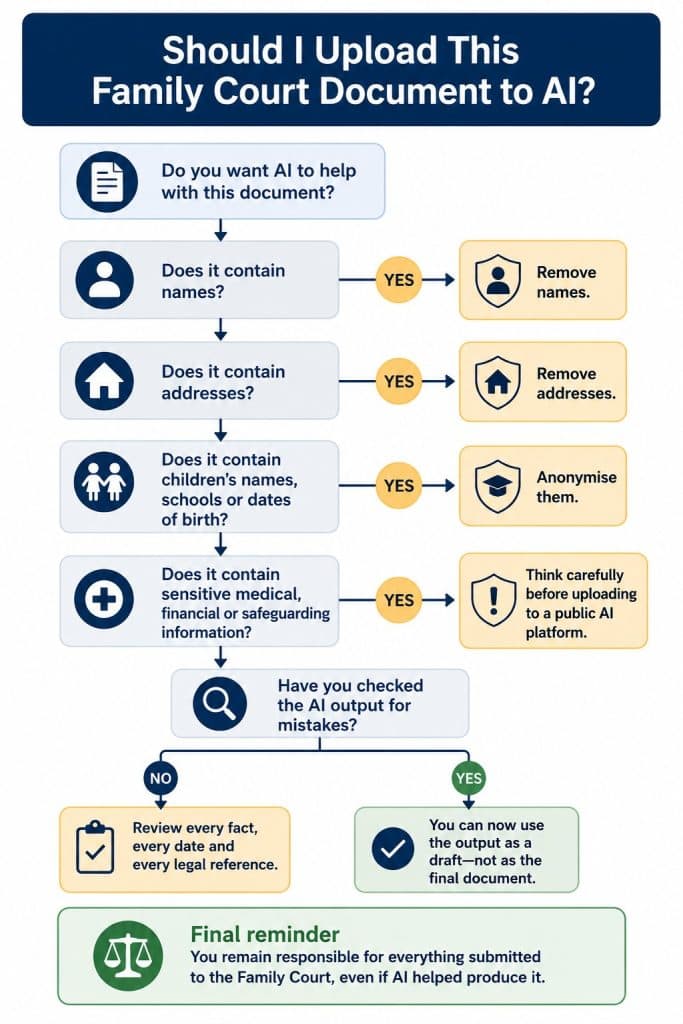
The safest approach is to provide the minimum information needed for the task.
If you only want help understanding one paragraph of an order, there is usually no reason to upload the whole order. Copy the relevant passage, remove identifying information and explain what kind of document it comes from.
The same principle applies to a Cafcass report, witness statement or Form E. Start with the smallest useful extract, not the complete case file.
How to anonymise a document
Anonymising means more than replacing the child’s name with an initial.
Remove or generalise names, dates of birth, addresses, schools, employers, case numbers, email addresses, telephone numbers and account details. A rare occupation, small school, exact date and unusual family history may still identify the people involved even when their names have gone.
You might replace names with “the mother”, “the father” and “Child A”. A school can become “the child’s school”, and an address can become “the former family home”.
Be especially careful with PDFs. Personal information may remain in headers, footers, comments, bookmarks, filenames or hidden text layers. Covering a name with a black rectangle does not always remove it.
After redacting a document, search for the original name, try to select and copy the hidden text, and check the filename and document properties before uploading it.
Should you use a specialist legal AI tool?
For many ordinary tasks, a consumer AI tool is enough.
You do not need professional legal software merely to organise dates, improve grammar or shorten an email. The difficulty begins when the task depends on verified legal research, current procedure or professional judgement.
Specialist tools such as LexisNexis and CoCounsel are built around authoritative legal materials and source checking. They are mainly designed for legal professionals, but they show why legal research is different from general AI writing.
Using a second chatbot to check the first one can expose an obvious mistake, but it is not proper verification. Two systems can repeat the same error.
A deadline should be checked against the actual order. A procedural point should be checked against current official guidance. A reported case should be opened and read.
How I use AI as a McKenzie Friend
I use AI as part of my working process, but not as the person deciding the case.
It can help organise information, compare documents, identify repetition and test whether a draft is clear. It may help turn long notes into a first chronology or show where a client’s account moves from fact into assumption.
That is only the beginning.
The chronology still needs to be checked against the original messages. The position statement still needs to reflect the client’s real circumstances. A proposal still needs to work around the child’s school, travel, employment, finances and any safeguarding concerns.
AI may also agree too easily with the way a client first describes the case. Human support sometimes means asking harder questions.
Does the document prove what you think it proves?
Is the point relevant to the next hearing?
Are you asking for something realistic?
Have you explained the effect on the child?
Could the message reasonably be interpreted in another way?
These are not simply writing questions. They require judgement and an understanding of the case as a whole.
AI can reduce the time spent on mechanical tasks. Human support can concentrate on relevance, preparation and strategy.
Useful prompts for a Litigant in Person
The best prompts give AI a defined task and tell it what not to assume.
Understanding a court order
Explain this extract from a Family Court order in England and Wales in plain English. Separate the actions required, the deadlines and anything unclear. Do not add requirements that are not written in the order.
Organising a chronology
Arrange these events in date order using only the information provided. Separate confirmed facts from allegations, mark uncertain dates and do not infer motive.
Reviewing a position statement
Review this draft for clarity, relevance and repetition. Identify anything that does not help explain the present issue or the order I am asking the court to make. Do not add facts or legal authorities.
Preparing for Cafcass
Ask me neutral questions that will help me explain the current arrangements, my concerns, my proposal and how it would meet the child’s needs. Do not provide model answers.
Reviewing financial disclosure
Compare this document list with the documents received. Identify missing periods, missing statements or figures that need clarification. Do not accuse either party of hiding assets.
Reducing conflict in a message
Rewrite this message so that it answers the practical issue briefly and calmly. Preserve my proposal, but remove insults, speculation about motive and repeated history.
Testing your own case
Review my proposal from the perspective of a fair but critical court professional. Identify practical weaknesses, missing information and questions I should be ready to answer.
Before relying on anything AI has written
Read the final document as though the judge or the other party’s representative were questioning you about every sentence.
Can you identify the source of each important fact?
Do the dates, quotations and figures match the originals?
Has an allegation been written as though it were proved?
Has a Cafcass recommendation been described as though it were an order?
Has the AI inserted a legal phrase you do not understand?
The document should also still sound like you. Clear writing helps. Artificial legal language can make it harder to answer questions later.
Frequently asked questions
Can I use ChatGPT for my family court case?
Yes. It can help explain terminology, organise information, prepare questions and improve writing. Important legal information should still be verified.
Which is better for family court work: ChatGPT, Claude, Gemini or Perplexity?
There is no permanent winner because these tools change frequently.
ChatGPT and Claude are often useful for drafting, organising and reviewing longer text. Gemini may be convenient for people already using Google products. Perplexity can be useful for finding current sources.
The best tool depends on the task, privacy settings and how carefully the answer is checked. None should be treated as automatically reliable simply because it performs well in another area.
Can AI write my position statement?
It can help structure or edit a draft, but the facts, position and proposal must remain yours. You are responsible for every sentence filed with the court.
Can AI help with Child Arrangements proceedings?
Yes. It can explain parts of the process, organise the history and help develop a practical proposal. It cannot decide what arrangement is in the child’s best interests.
Can AI help me prepare for Cafcass?
It can help you practise explaining the arrangements, concerns and proposals. It should not be used to create rehearsed answers designed to manipulate the recommendation.
Can AI analyse messages from the other parent?
It can organise and summarise them. It cannot reliably determine motive, coercive control, dishonesty or parental alienation from selected extracts alone.
Can AI help with divorce and Form E?
It can explain unfamiliar wording, organise financial records and identify missing documents. It should not decide whether disclosure is complete or what settlement is fair.
Is it safe to upload a Cafcass report?
Uploading a complete report to a consumer AI platform creates privacy and confidentiality risks. Where possible, use an anonymised extract containing only the information needed for the task.
Can AI produce a transcript of a hearing?
AI can create an informal transcript from a lawful recording, but that is not the same as an authorised court transcript. A party must not record a hearing without permission or lawful authority. The proper court process should be used where an official transcript is required.
Do I have to tell the judge that I used AI?
There is currently no general requirement in Family Court proceedings in England and Wales to declare every use of AI. You must answer honestly if asked and remain responsible for the final document.
Can AI replace a solicitor or McKenzie Friend?
No. It can reduce administrative work and improve preparation, but it cannot exercise human judgement, understand the whole family situation or support someone through a hearing.
So, should you use AI for your family court case?
Yes, provided you remain in control of it.
AI can make the Family Court more accessible for a Litigant in Person. It can explain unfamiliar language, organise large amounts of information and improve written communication.
Its value will depend on the case. In Child Arrangements proceedings, it may help clarify the history and proposals. In divorce, it may help separate the divorce process from financial issues. In financial remedy, it may help organise disclosure. In high-conflict proceedings, it may help reduce unnecessary communication and focus on the practical issue.
The danger begins when AI is asked to make decisions that depend on evidence, credibility, safeguarding or legal judgement.
Use it to organise information, reveal questions and improve clarity.
Check important law and procedure against reliable sources.
Seek human support when the issue is complex, heavily disputed or carries serious consequences.
The aim is not to produce the most impressive-looking document. It is to understand your case, present accurate information and make a proposal the court can properly consider.
Used in that way, AI is not a shortcut around the Family Court process.
It is a practical tool that can help you take part in it more effectively.
Vélemény, hozzászólás?