When comparing online divorce vs DIY divorce, you will quickly find companies offering packages described as online divorce, managed divorce, fixed-fee divorce or divorce application services.
The advertising can make it appear as though applying online is a special service that needs to be purchased.
But there is an important point to understand before paying anyone:
The official divorce application in England and Wales is already available online.
You can apply directly through the government service yourself.
That does not make commercial online divorce services pointless. Some people may genuinely value having somebody else organise the administration, check information or keep track of the application.
The useful question is therefore not:
“Can I get divorced online?”
You already can.
The better question is:
“What am I paying this company to do that I do not want to do myself?”
“Online Divorce” Can Mean Different Things
There is no single package that every online divorce company provides.
One provider may simply help prepare information for the divorce application.
Another may manage much of the administration and communicate with you as the application progresses.
A more expensive package may include additional document checking, support when something goes wrong, or access to somebody who can answer questions.
That means two services both advertised as an online divorce may actually provide very different levels of support.
The headline price therefore tells you very little unless you know what is included.
Before comparing providers, look beyond the words “online divorce” and identify exactly what the company will do for you.
The Government Online Service Is Already Available Directly
Individuals in England and Wales can make a divorce application themselves using the official online service provided through GOV.UK.
The current court fee for filing a divorce application is £628.
That court fee is particularly important when comparing commercial packages.
A company may advertise a relatively low service price, but you need to establish whether the court fee is:
- included in the advertised price;
- added separately at checkout; or
- paid directly by you during the application.
A £199 or £299 divorce package, for example, does not necessarily mean that £199 or £299 is the total cost of obtaining the divorce.
Always look for the total amount you will actually pay, rather than comparing only the company’s service fee.
So What Are You Paying a Divorce Company For?
In most cases, you are paying for some combination of convenience, administration and support.
That may have real value.
Some people hate dealing with online forms. Others are worried about entering something incorrectly. Some simply do not want another administrative job during an already difficult separation.
A commercial provider may therefore save time or reduce uncertainty.
But that is different from paying for access to a special divorce process.
The underlying court process is still the court process.
The value of the commercial service lies in what the company does around that process.
This is why it is useful to break a package down into individual tasks.
For example:
Are they completing the application information with you?
Are they checking what you enter?
Are they actually submitting anything on your behalf?
Will somebody monitor the application?
Will they tell you when you need to take the next step?
Can you speak to a person if something unexpected happens?
Once you know the answers, it becomes much easier to decide whether the price represents good value for you.
Check Who Is Actually Providing the Service
The words used in online divorce advertising can sometimes be confusing.
A polished website may describe a service as professional, expert-led or fully managed, but those descriptions do not automatically tell you who will actually be working on your case.
Before paying, check:
- who operates the business;
- what type of support is actually being provided;
- whether legal advice is included;
- whether a solicitor or regulated law firm is involved;
- whether document preparation is included;
- how you communicate with the company; and
- what happens if your situation falls outside the standard package.
This is not about assuming that one type of provider is automatically better than another.
It is about knowing what you are buying.
If you believe you are paying for legal advice when the package actually provides only administrative assistance, that is a significant difference.
Equally, if all you want is somebody to take care of the administration, there may be little point paying for services you do not need.
Look Carefully at the Add-Ons
The initial package is not always the final package.
Additional charges may arise for services such as:
- additional document checking;
- amendments;
- extra correspondence;
- dealing with an application that becomes less straightforward;
- certified or replacement documents;
- additional telephone support; or
- other work outside the basic package.
This does not necessarily mean the provider is doing anything wrong.
Many businesses quite reasonably charge more when additional work becomes necessary.
The important thing is that you know this before buying.
A low entry price is less useful if the services you are likely to need are all charged separately.
Do You Actually Want a Fully Managed Service?
For some people, the answer will be yes.
You may already be dealing with work, children, moving home and the practical consequences of separation.
Paying somebody to handle as much of the divorce administration as possible may simply make life easier.
That can be a perfectly sensible purchase.
The mistake is assuming that everybody needs the same level of service.
Someone who is comfortable using online government services, uploading documents and following instructions may need very little assistance.
Another person may be comfortable doing most of it but want somebody available when they are uncertain.
The right level of support depends partly on how much of the process you actually want somebody else to manage.
DIY Does Not Have to Mean Completely Alone
This is where the choice becomes more interesting.
People often think in terms of two extremes:
Do everything yourself.
or
Pay a company to manage everything.
There is another option.
You can deal with straightforward administrative steps yourself and obtain targeted support only when you need it.
That might mean getting help understanding correspondence, checking what a document is asking for, organising information or working out what practical step comes next.
For some people, this approach provides a better balance between cost and support.
You remain responsible for your own application rather than paying somebody to manage every stage, but you are not left trying to understand everything without assistance.
If you decide that you would like practical support but want to understand the different options available, you can also explore the McKenzie Friend Guide, which introduces McKenzie Friends and family court support professionals through individual profiles and interviews.
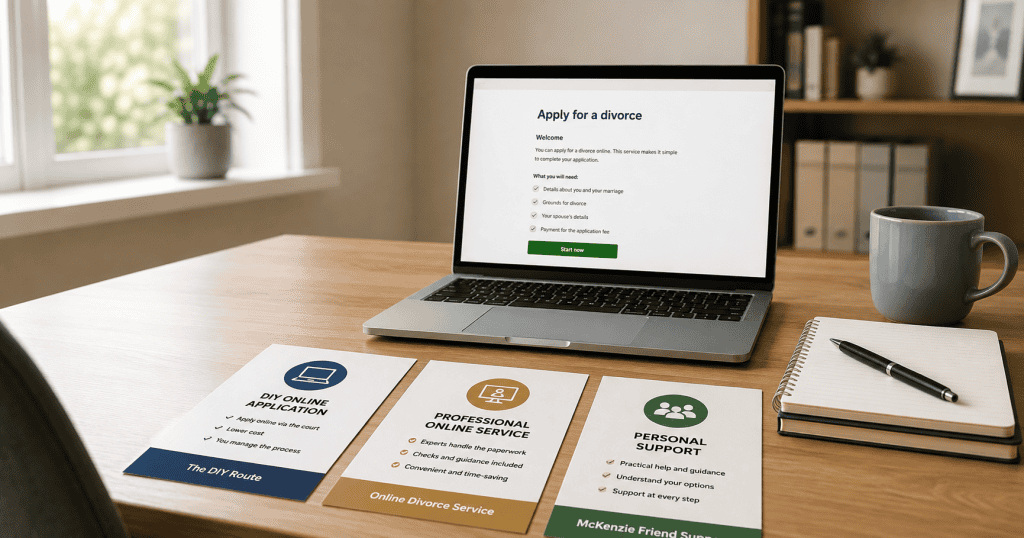
A Simple Way to Compare the Three Approaches
Apply directly yourself
This may suit you if you are comfortable with online forms, can follow the government guidance and are happy to manage the application yourself.
Your main external cost is the applicable court fee, subject to any eligibility for Help with Fees.
Use a commercial online divorce service
This may suit you if convenience is important and you would prefer somebody else to manage or assist with the administration.
The key question is whether the additional service fee is worthwhile for the amount of work they are actually taking away from you.
Apply yourself but get support when needed
This may suit you if you are comfortable handling straightforward parts of the application but want practical help when you reach something you do not understand or when other family-court issues begin to develop.
There is no reason that support has to be purchased as one large package at the beginning.
Nine Questions to Ask Before Paying for an Online Divorce Package
Before entering your card details, find the answers to these questions:
- What exactly does the advertised price include?
- Is the £628 court fee included or separate?
- Who will actually deal with my application?
- Does the service include legal advice, administration, or both?
- Can I speak to a real person if I have a problem?
- Are there additional charges if something unexpected happens?
- What work will I still need to complete myself?
- What is the cancellation or refund policy?
- Could I comfortably complete the government application myself and pay for help only if I need it?
These questions make it much easier to compare services on substance rather than marketing.
The Cheapest Package Is Not Necessarily the Best Value
Price matters, but value is more complicated.
A very cheap service that provides little more than information you could easily follow yourself may not save you much time.
A more expensive service that genuinely removes hours of administration may be worthwhile to somebody who wants that convenience.
Likewise, paying nothing beyond the court fee may be the right choice for somebody who is comfortable handling the application independently.
The point is not that DIY is always better.
It is that you should be able to explain, in one sentence, what the additional money is buying you.
If you cannot do that after reading the provider’s website, look more carefully before paying.
Do Not Buy Support for the Wrong Problem
Sometimes people start searching for an “online divorce service” because divorce is the word they know.
But the divorce application may not actually be the part causing the difficulty.
The real problem may be communication, court documents, arrangements involving children or another Family Court issue.
In that situation, paying somebody simply to manage a straightforward divorce application may not address the problem that is taking most of your time and energy.
Think about where you actually need assistance before deciding what type of service to buy.
For an overview of the practical support available across divorce, children and family court matters, visit my Support & Help page
For financial matters following separation or divorce, see the dedicated Financial Remedy Support guidance and The Divorce Is Final — But Are Your Financial Claims Still Open?
Those issues are covered separately rather than being bundled into the price comparison here.
Where Everyman Justice Fits
Everyman Justice does not require you to hand over every straightforward part of the process simply because you need help with one particular issue.
The focus is practical, targeted support.
If you are comfortable dealing with the online divorce application yourself but later need help understanding documents, preparing for Family Court proceedings or organising what needs to be done, support can be focused on that particular problem.
A McKenzie Friend is not a solicitor and does not replace regulated legal advice where that is required.
The aim is simply to avoid paying for support you do not need while still having practical assistance available when you do.
The Bottom Line
An online divorce and a DIY divorce are not necessarily two completely different ways of getting divorced.
The official application itself is already available online.
The real difference is usually the amount of additional help you choose to purchase around it.
For some people, paying a commercial provider to manage the administration will be money well spent.
For others, the government online service may be perfectly manageable, particularly with the careful use of AI to help explain information, organise documents and understand what needs to be done, without paying an additional company.
And some people will prefer the middle ground: deal with the straightforward parts themselves and obtain practical support only when a genuine difficulty arises.
Before paying for any package, understand the total cost, what is included, what remains your responsibility and what problem you are actually trying to solve.
Pay for the support you need — not simply for the word “online”.
Leave a Reply